Frequently asked questions
What makes a solar panel cleaning brush safe for anti-reflective (ARC) coatings?
To be ARC-safe, filaments must have an ultra-fine diameter (0.15 mm to 0.22 mm) and preferably flagged (split-end) tips. When paired with continuous water flow, these soft bristles yield upon contact, preventing trapped quartz or silica particles from acting as sandpaper on the glass coating.
Can IndusBrush manufacture replacement roller brushes for robots like SolarCleano or WashPanel?
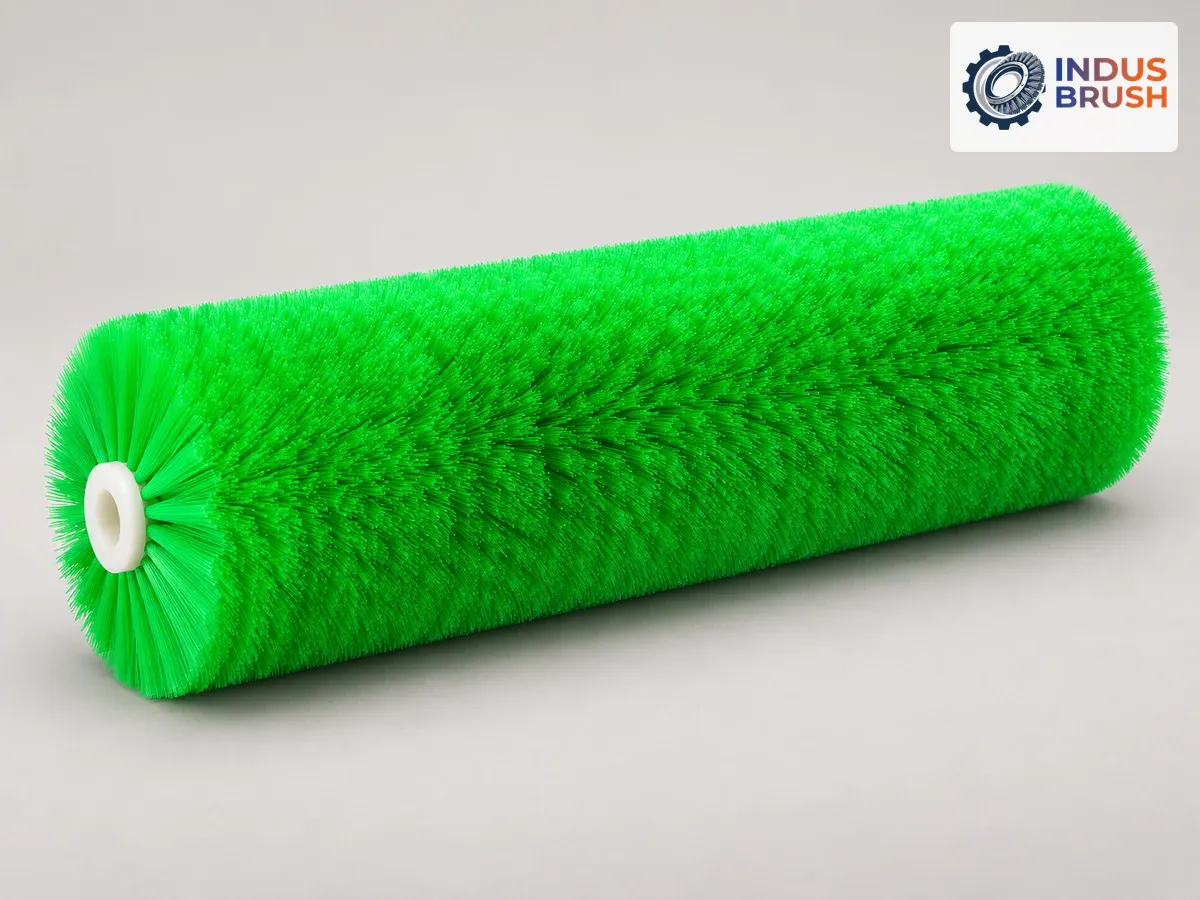
Yes. We custom-manufacture replacement roller brushes matching the exact dimensions, core types, and drive end profiles of major commercial cleaning robots, including SolarCleano (M1, F1, L1, B1), WashPanel, and SunBrush. We supply standard lengths from 800 mm to over 2450 mm, diameters of 170 mm, 220 mm, and 380 mm, and custom hexagonal, splined, or keyway shaft couplings.
What is the difference between dry cleaning and wet cleaning solar robot rollers?
Dry cleaning rollers use ultra-soft (0.15 mm-0.18 mm) blue-coded nylon bristles engineered with anti-static properties to dislodge loose desert sand without water. Wet cleaning rollers utilize standard (0.20 mm-0.25 mm) yellow or green spiral bristles optimized to scrub wet mud, bird fouling, and baked-on dust when paired with robot spray bars.
What details are needed to order a replacement solar cleaning robot roller brush?
Provide the robot make and model, working face length, outside diameter across bristle tips (OD), core body OD and material (aluminum or polymer), drive end shaft profiles (hex size, keyway, or spline dimensions), and whether the brush operates wet or dry.
How do water-fed solar brush heads connect to telescopic poles and water lines?
Our water-fed heads feature a universal Euro-thread socket compatible with standard angle goosenecks and carbon-fiber telescopic poles. Dual spray nozzles connect via push-fit quick couplings to standard 8 mm or 10 mm OD polyurethane water-fed pole hose.